
Quartzite Countertop Repair in Richmond, VA
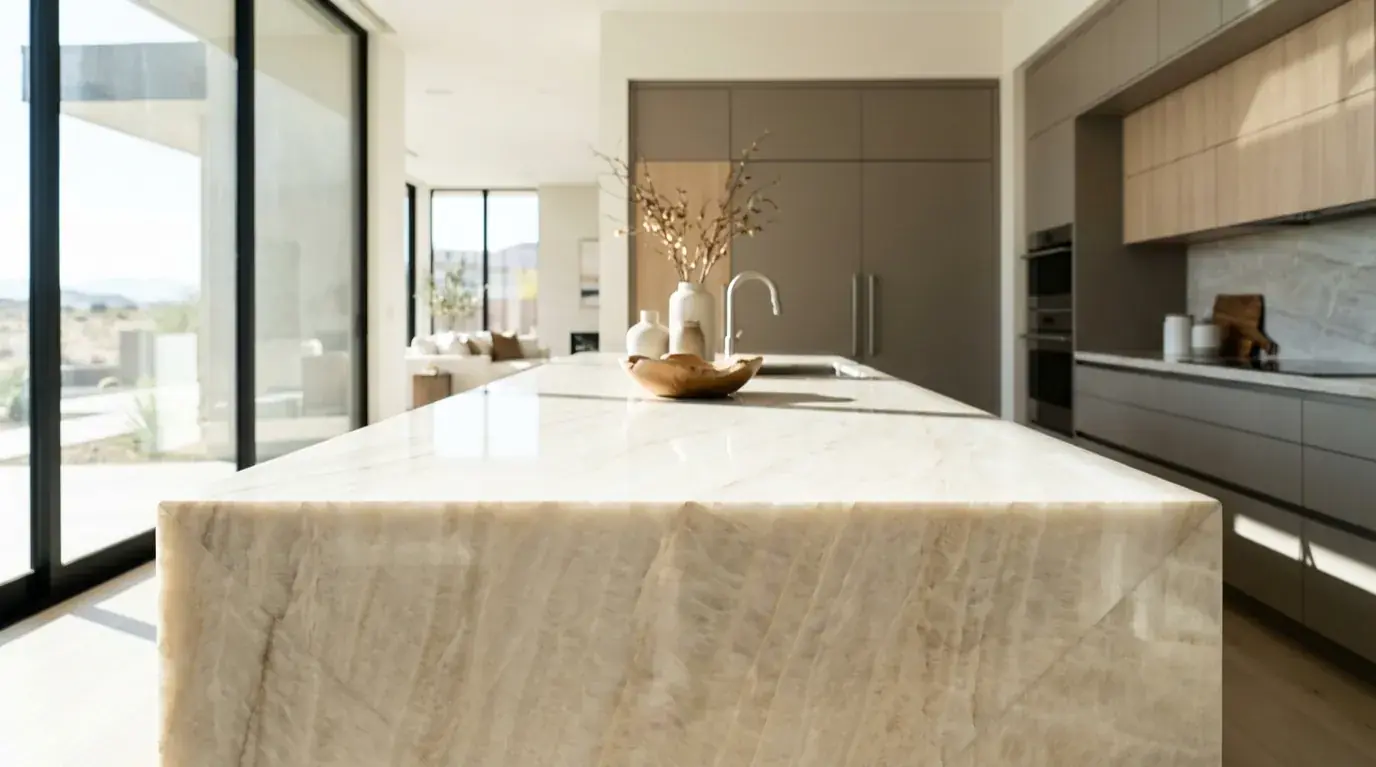
Quartzite is one of the most striking natural stones available for countertops. It can offer marble-like movement with the hardness people expect from granite, which makes it especially popular for large islands and waterfall edges. Because some visually similar stones are also sold as quartzite, we confirm the material before choosing a cleaner, sealer, or restoration process.
Google Reviews
Scroll to read all 9 reviews →
“Great work and even better customer service. Very professional, easy to work with, and you can tell they take pride in what they do. Definitely recommend Precision Floor & Surface Restoration if you need your floors or countertops brought back to life.”★★★★★
“Absolutely amazing work! From start to finish, everything was handled professionally and with great attention to detail. They took the time to make sure everything was done right, and the results speak for themselves. The floors and surfaces came out looking incredible, and you can tell they genuinely take pride in their work. I couldn’t be happier with the finished product and would definitely recommend them to anyone looking for quality work and great service. Five stars all the way! ⭐⭐⭐⭐⭐”★★★★★
“Precision Floor & Surface Restoration exceeded my expectations! Professional, punctual, and detail-oriented from start to finish. My floors look amazing, and the quality of work was outstanding. Highly recommend to anyone looking for top-notch floor and surface restoration services.”★★★★★
“Removed stains that previous cleaning services could not. Made the impossible - possible!”★★★★★
“Great quality work! Very professional with communication!!”★★★★★
“Clean and very professional. Highly recommend”★★★★★
“I highly recommend his floor cleaning services! He’s reliable, professional, and does an excellent job. My floors looked amazing, and I couldn’t be happier with the results.”★★★★★ ★★★★★
Why identifying quartzite matters
Genuine quartzite is a silica-based natural stone. It resists common kitchen acids and can usually be honed or polished when the finish becomes worn.
Marble and dolomitic marble can have similar veining, but they contain minerals that react with lemon juice, wine, and other acids. They need a different restoration process.
If a countertop sold as quartzite develops a pale, rough etch after an acidic spill, we verify the stone before doing anything else. That one step protects the surface from the wrong treatment.
What makes quartzite durable
It began as sandstone, a sedimentary rock of quartz sand grains. Heat and pressure over geologic time fused those grains so completely that the boundaries between them essentially vanished.
The result is dense and crystalline, and the process is the same kind of metamorphism that turns limestone into marble. The difference is entirely in the starting material: silica-based rather than calcium-based.
Hardness comes out around Mohs 7, generally at or above granite. That makes genuine quartzite one of the toughest natural surfaces available for a countertop.
Porosity is where it refuses to generalize. Some varieties compressed into extremely tight stone. Others stayed noticeably absorbent and take up liquids, sealer included, far more readily. Two slabs both correctly labeled quartzite can want quite different maintenance.
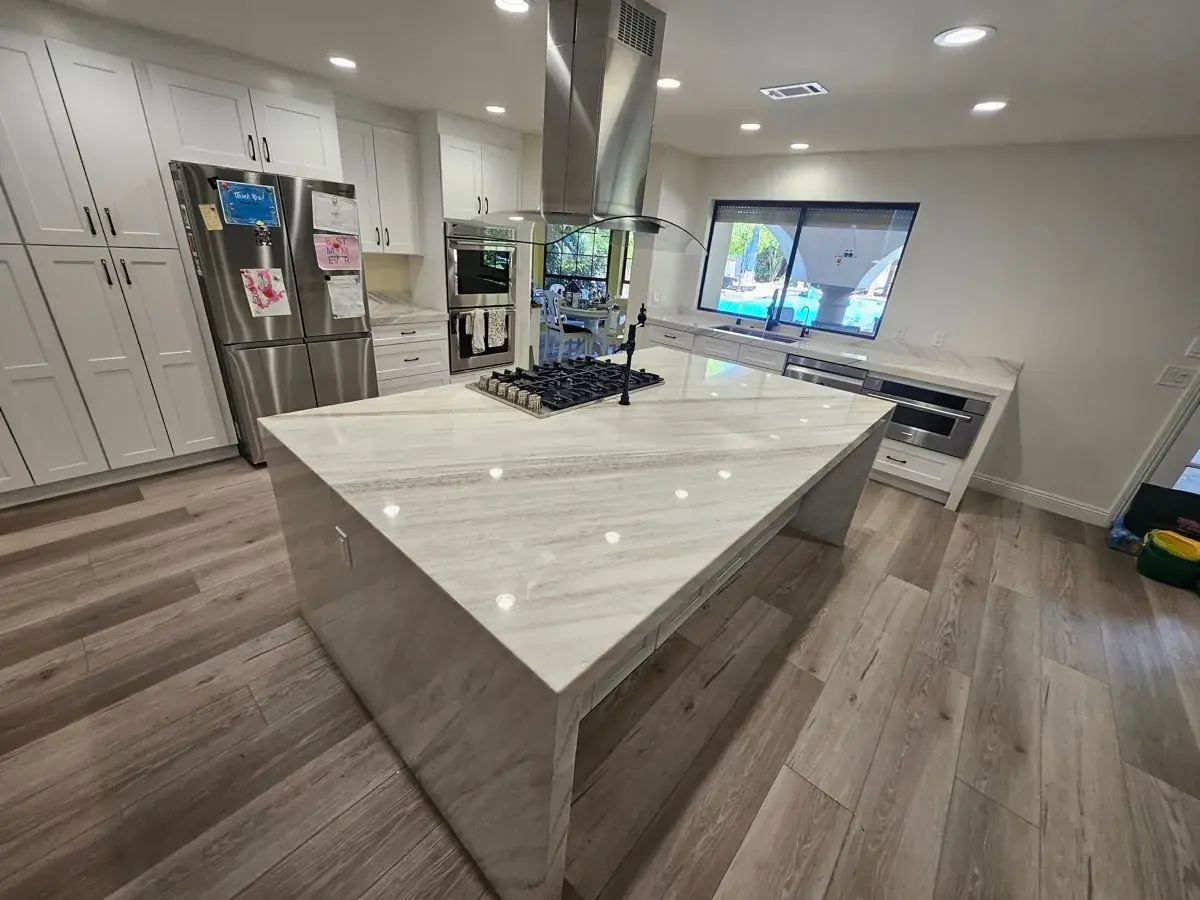
What we get called about around Richmond
- Etching on something sold as quartzite, which nearly always resolves to a mislabeled calcareous slab rather than quartzite misbehaving
- Staining on the more absorbent varieties, where oil and other liquids work into the pore structure much as they would on granite
- Chips and cracks at the usual stress points, sink cutouts, unsupported overhangs, and corners, driven by installation and impact rather than any defect in the stone
- Sealer thinning sooner than expected on porous varieties, which need closer attention than a dense slab ever will
Residue, stain, etch, or damage?
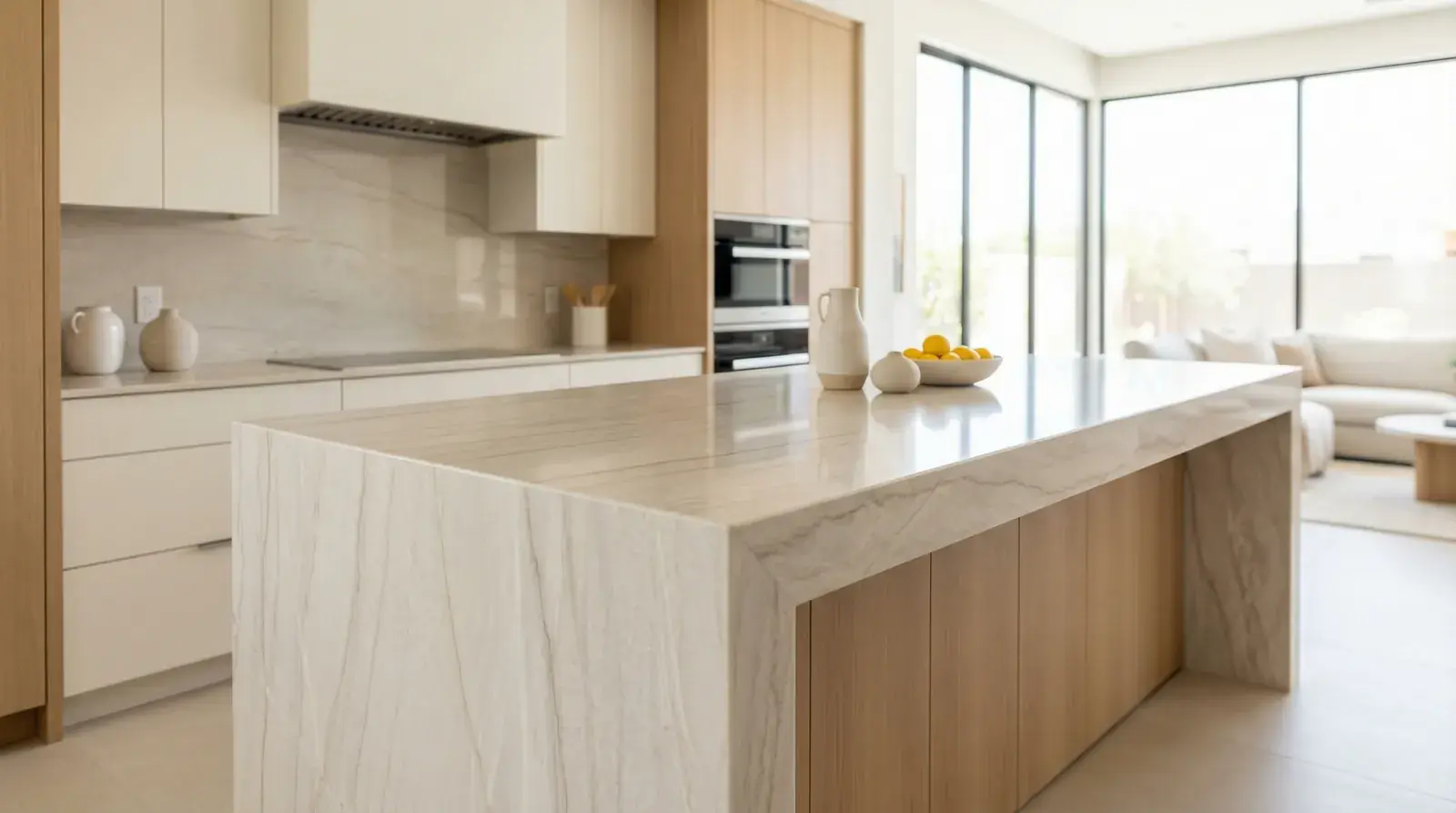
The four categories work here as everywhere, with one extra step: on quartzite, an apparent etch is a reason to question the material rather than a finding in itself.
- Residue or film is surface-level buildup, cleaner or soap, and it comes off without restoration work.
- Stain means absorption into the pore structure, reading darker with the texture unchanged. Entirely plausible on a porous variety, same as granite.
- Etch should not occur on genuine quartzite. So if a spill left a dull, pale, rough patch, stop and verify what the stone is before choosing any treatment. That mark is evidence about the material, not just about the damage.
- Damage covers chips, cracks, and open seams. Mechanical, traceable to installation or impact, and needing the support underneath examined first.
How we approach a quartzite counter
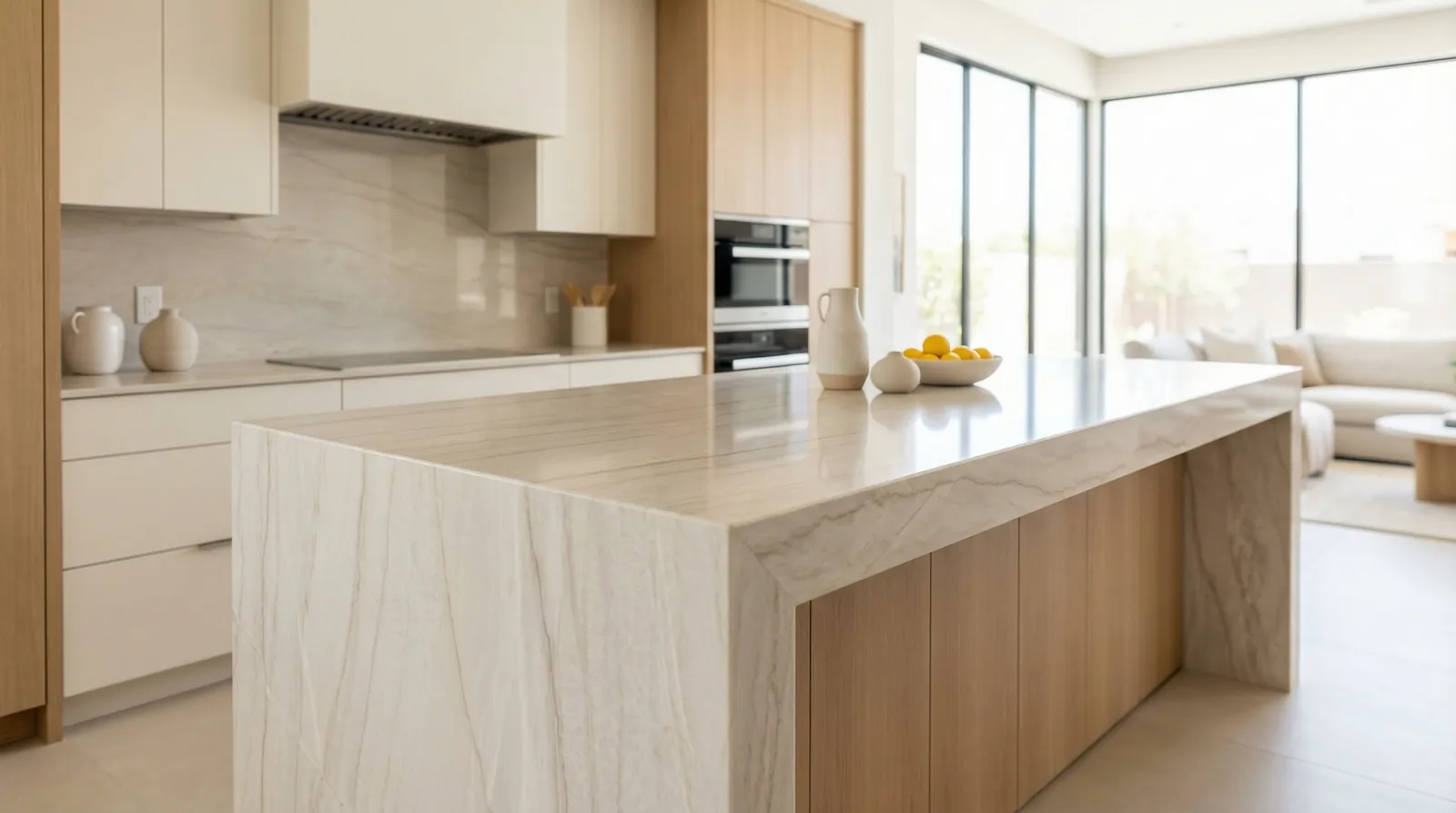
- Settle the identification, and do it first. A discreet acid test in a hidden spot separates genuine siliceous quartzite from mislabeled calcareous stone in a couple of minutes, and that answer determines every choice that follows.
- Read the mark in raking light. Darkening when wet points toward staining. Dull and rough regardless points toward an etch, which loops back to question one.
- Look at the assembly, not just the surface. For any chip or crack, cabinet support and cutout condition matter exactly as much as they do on granite.
- Work upward from the gentlest option. Dry inspection, pH-neutral clean, look again, then a hidden test spot before solvents, poultices, or abrasives go anywhere visible.
What the work looks like
Genuine quartzite is natural stone, so the approach runs close to granite’s.
- Stains come out with an absorbent poultice carrying the right solvent, left 24 to 48 hours to draw the mark back up out of a porous slab.
- Small chips get a color-matched epoxy or acrylic fill, shaved back flush.
- Dull patches and light scratching may respond to quartzite honing and polishing, blended into the surrounding area after the material has been confirmed.
- Sealer goes on when an absorption test on your slab says so. See why testing comes before a sealer application, especially when quartzite porosity varies so widely.
- If it turns out to be calcareous after all, the plan switches to the marble approach. Etches need mechanical correction, and no poultice touches them on any calcium-based stone.
Where quartzite restoration has limits
A large or moving crack needs a full inspection before we promise a result. Its location, the support below it, and the condition of the surrounding stone determine whether a repair is appropriate.
An old, deep stain in a porous variety will often lighten considerably rather than vanish completely.
If the slab turns out to be a softer calcareous stone, the plan changes to a marble-style restoration process. Correct identification protects the countertop from an incompatible treatment.
Everyday situations that can damage quartzite
Quartzite is hard, but it is not maintenance-free. Cooking oil can soak into a porous slab, standing water may darken an area near the sink, and a heavy pan can chip an exposed edge.
Acidic spills add another clue. Genuine quartzite should resist them. If lemon, wine, or a household cleaner leaves a light, rough mark, the surface may be marble, dolomitic marble, or another stone sold under the quartzite name.
Clean spills promptly, use a pH-neutral stone cleaner, and test how quickly the countertop absorbs water. Those simple checks tell us more about the care it needs than a generic sealing schedule.
How Richmond humidity affects quartzite
Richmond’s humidity can keep moisture around sinks, seams, and dish racks from drying quickly. On a porous quartzite slab, that extra contact time may lead to dark spots or an uneven appearance when the sealer has worn thin.
Keep wet areas dry, address leaks and open seams early, and reseal when an absorption test shows the stone is taking in water. Heat usually does not harm the quartzite itself, but trivets still protect repair resins and nearby seams.
How to care for quartzite
- pH-neutral stone cleaner rather than anything acidic or abrasive
- Trivets and cutting boards, since a hard stone still carries a finish that abrasion can mark
- Run a water-drop absorption test now and then, particularly if nobody ever told you how porous your slab is
- Deal with oil and spills promptly on anything that tests as even moderately absorbent
- If you have never had the material confirmed, get it confirmed rather than assuming the label
When it is worth a call
Call if a counter sold as acid-resistant quartzite has etched, because that is the clearest signal on this page and it usually means the slab is something else. Call for any chip or crack near a cutout, and before resealing over a mark that has not been resolved.
A photo helps, and so does whatever you know about the purchase: where the slab came from and exactly what it was called on the invoice.
Common quartzite questions
My "quartzite" countertop etched from lemon juice, how, if quartzite is acid-resistant?
Genuine quartzite is silica-based and normally resists common kitchen acids. Marble, dolomitic marble, and other visually similar stones can be sold under the quartzite name, and those surfaces may etch from lemon juice. Have the material confirmed before treating the mark so the repair matches the actual stone.
How can I tell if my countertop is real quartzite or mislabeled marble?
There is a simple chemical test, though not one to run on a visible surface. A drop of vinegar or lemon juice left for a minute or two will dull, etch, or faintly fizz on calcareous stone like marble, because acid is dissolving calcite. Genuine siliceous quartzite does not react at all. Done on an inconspicuous spot, under an overhang or inside a cutout, it settles the question in about two minutes. We usually pair it with a scratch check in the same hidden area, since real quartzite runs harder than most people expect.
Does quartzite need to be sealed?
Usually, and the amount varies more than it does with granite. Quartzite covers a wide porosity range depending on how completely the original sandstone was metamorphosed. Some varieties came out dense enough that sealer barely soaks in and rarely needs renewal. Others stay noticeably absorbent and drink it. Because that spread exists even within genuine quartzite, we would rather test your particular slab than quote you a schedule that might be wrong by years.
Can quartzite be honed or repolished like granite?
Yes, and that is one of the practical payoffs of confirming you have the real thing. Genuine quartzite is natural stone, so it responds to the same diamond-pad honing and repolishing sequence used on granite and marble. Dull patches and light scratching can be worked out and blended. The granite playbook transfers almost intact, which is not true of engineered surfaces.
Is quartzite more durable than granite?
Genuine quartzite is generally at least as hard, often harder, since it began as sandstone and then got compressed and heat-altered on top of that. Around Mohs 7 is typical. Just be careful what durable is being claimed to mean. Hardness resists scratching. It says nothing about porosity, and a porous quartzite left unsealed will stain like any absorbent stone. Hard and stain-proof are two different properties.
What causes chips or cracks in quartzite?
Almost always the installation rather than the stone. Overhangs carrying weight without support underneath, cabinets that were never leveled, stress concentrating around a sink cutout, or straightforward impact. The pattern matches granite closely. It is worth having the support checked before a chip or crack gets filled, because a fill over an unresolved structural cause tends to reopen along the same line.