
Quartz Countertop Repair in Richmond, VA
Quartz is a beautiful engineered surface that offers consistent color, low absorption, and easy everyday care. It does not need sealing and is highly resistant to common stains. The resin that binds the quartz together does require some caution around high heat, strong chemicals, rubber mats, and prolonged direct sunlight. When damage appears, we first determine whether it can be cleaned, repaired, or should be left alone.
Google Reviews
Scroll to read all 9 reviews →
“Great work and even better customer service. Very professional, easy to work with, and you can tell they take pride in what they do. Definitely recommend Precision Floor & Surface Restoration if you need your floors or countertops brought back to life.”★★★★★
“Absolutely amazing work! From start to finish, everything was handled professionally and with great attention to detail. They took the time to make sure everything was done right, and the results speak for themselves. The floors and surfaces came out looking incredible, and you can tell they genuinely take pride in their work. I couldn’t be happier with the finished product and would definitely recommend them to anyone looking for quality work and great service. Five stars all the way! ⭐⭐⭐⭐⭐”★★★★★
“Precision Floor & Surface Restoration exceeded my expectations! Professional, punctual, and detail-oriented from start to finish. My floors look amazing, and the quality of work was outstanding. Highly recommend to anyone looking for top-notch floor and surface restoration services.”★★★★★
“Removed stains that previous cleaning services could not. Made the impossible - possible!”★★★★★
“Great quality work! Very professional with communication!!”★★★★★
“Clean and very professional. Highly recommend”★★★★★
“I highly recommend his floor cleaning services! He’s reliable, professional, and does an excellent job. My floors looked amazing, and I couldn’t be happier with the results.”★★★★★ ★★★★★
Why quartz performs differently from natural stone
Quartz countertops are made from quartz aggregate, resin, and pigment. This combination creates a hard, consistent surface with very little pore space.
The resin is why quartz resists absorption and never needs sealer. It is also the part that responds to heat, strong chemicals, and long UV exposure.
That difference matters during restoration. Natural stone can often be honed and repolished, while aggressive sanding on quartz may disturb the factory finish and expose a different balance of resin and aggregate.
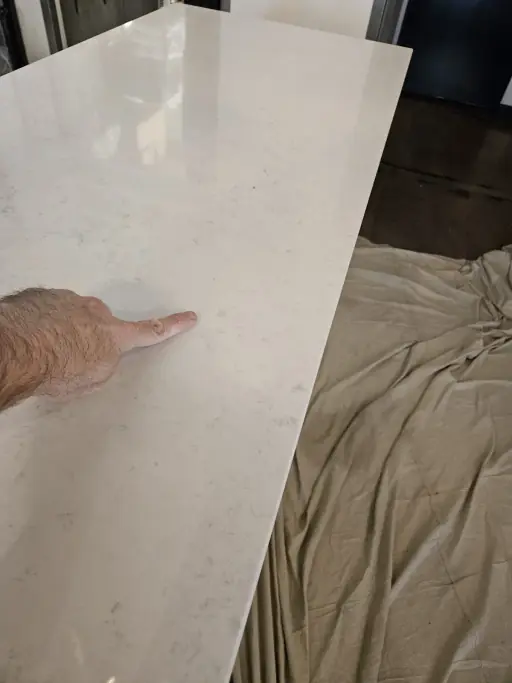
What can damage a quartz countertop
High heat can discolor or scorch the resin. Hot cookware and small appliances should always sit on a trivet or heat pad.
Direct sunlight may gradually yellow some quartz colors, especially when the same area receives strong sun every day.
Strong chemicals such as undiluted bleach, oven cleaner, heavy degreasers, and some solvents can leave haze or discoloration.
Rubber and silicone mats may transfer compounds into the resin when left in one place for weeks, sometimes leaving a yellow outline.
These problems can look like stains, but they are often changes within the resin rather than something absorbed through open pores.
What we get called about around Richmond
- Scorch marks near cooktops, air fryers, slow cookers, and heat lamps, showing as permanent white, yellow, or brown patches, sometimes with fine bubbling or crazing, and never cleaning off
- Yellowing under skylights and big unshaded south or west windows, since sustained direct sun is the exposure that matters while ordinary indirect window light generally is not
- Chemical clouding from undiluted bleach, strong alkaline cleaners, or solvents left in contact
- Mat-shaped discoloration from silicone or rubber pads, routinely reported to us as a water stain
- Dull halos left by melamine foam scrubbers, which strip factory sheen wherever they are used
- Chips and cracks, mostly impact or thermal shock at edges and seams, plus slow resin fatigue where a dishwasher vents steam against the underside year after year
Residue, stain, etch, or damage?
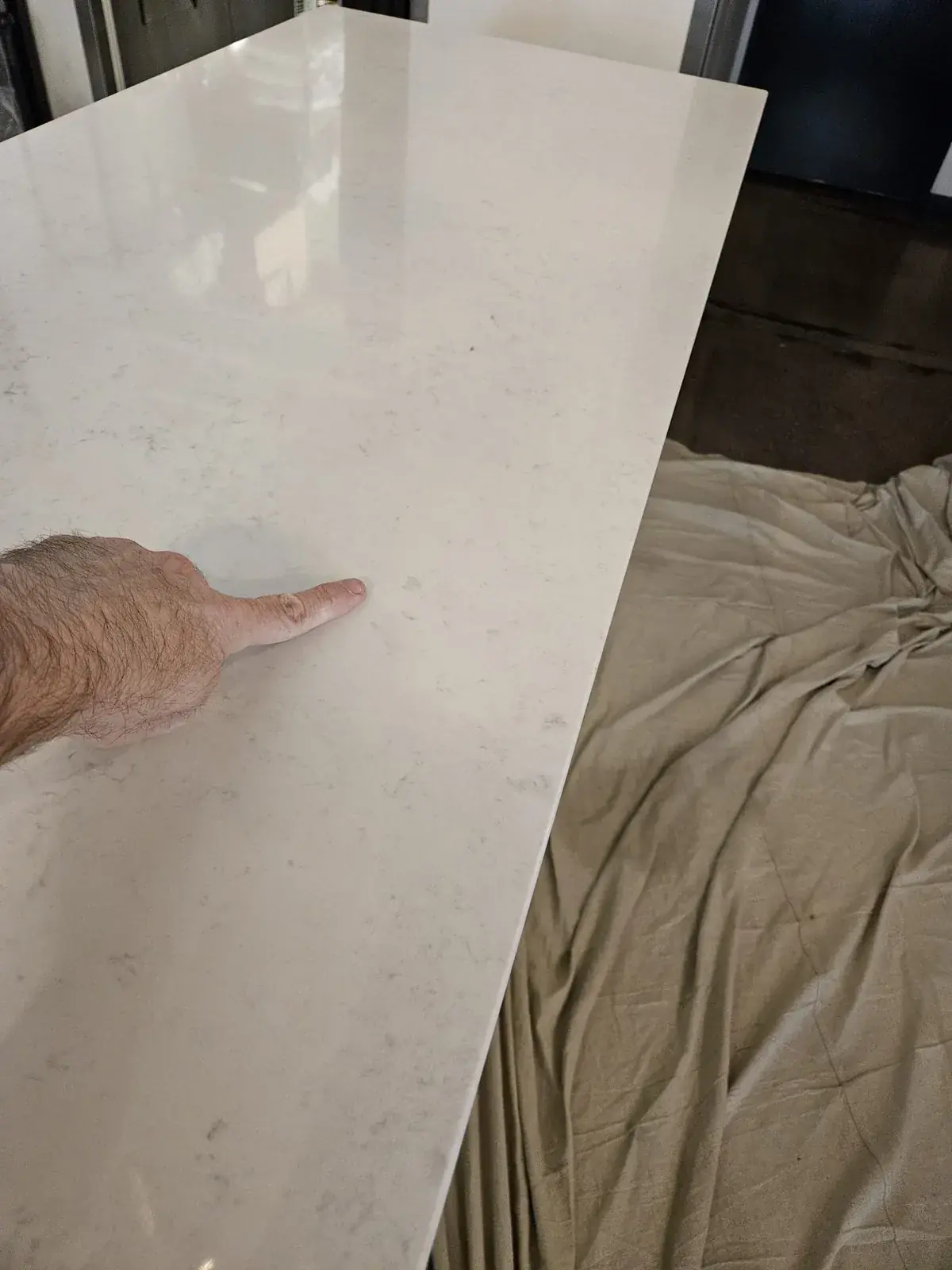
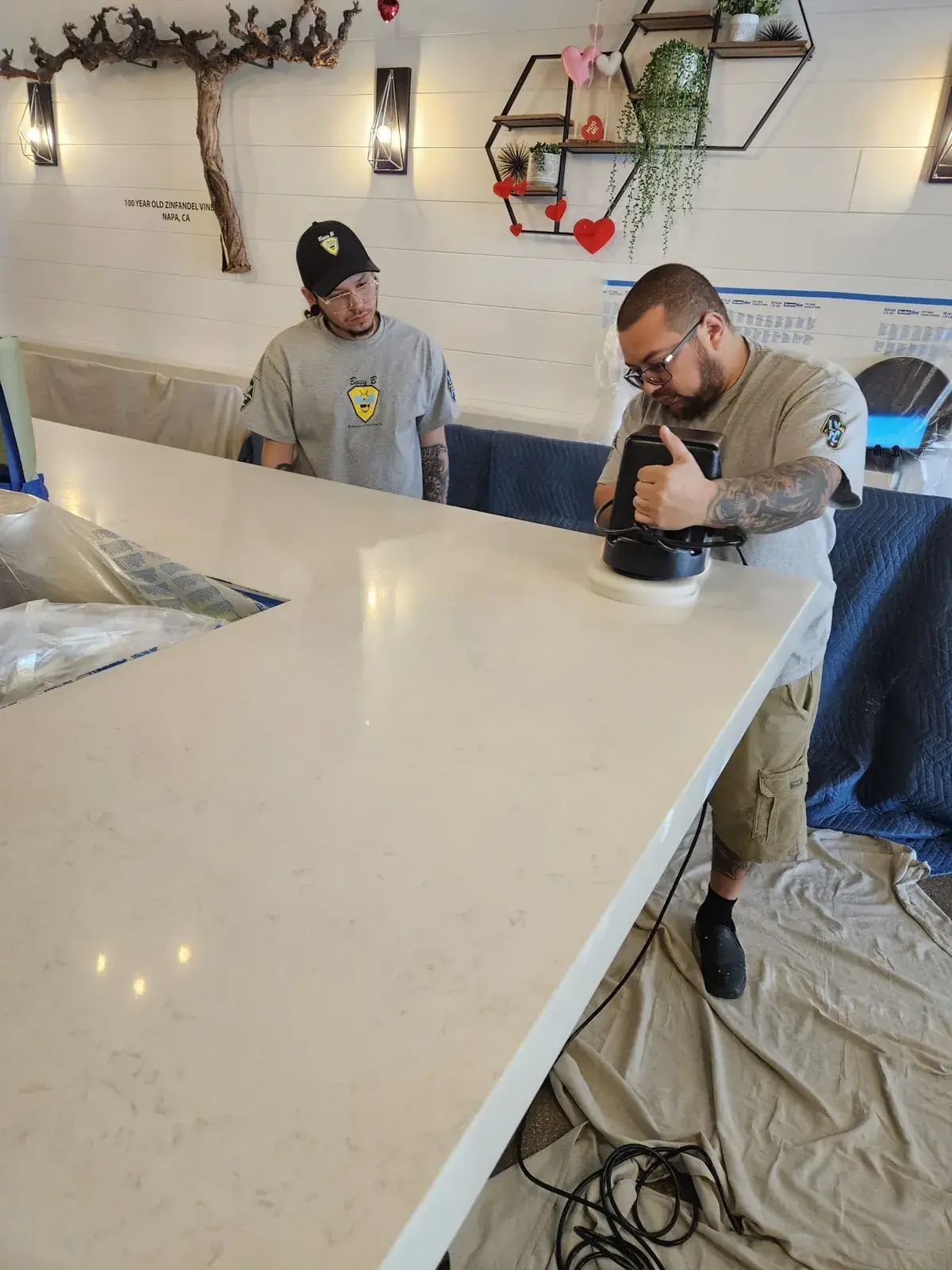
Near-zero porosity shifts how these four categories land compared with natural stone.
- Residue or film is the most common thing that looks alarming and is not. Cleaner buildup or light spotting sitting on the surface, gone with a soft cloth and a pH-neutral cleaner.
- Stain, in the true sense of absorption, barely happens on quartz. The imposter is plasticizer migration, which looks like a spill but is a chemical change inside the resin. Worth ruling out before anyone attacks it as a stain.
- Etch does not apply here at all, because there is no calcium carbonate for acid to react with. What resembles it is chemical clouding from bleach or a strong alkaline product, a different mechanism needing a different answer.
- Damage covers scorching, UV yellowing, chips, and cracks. All resin or impact driven, none of them absorption, and each needs its specific cause identified before anything is attempted.
How we approach a quartz counter
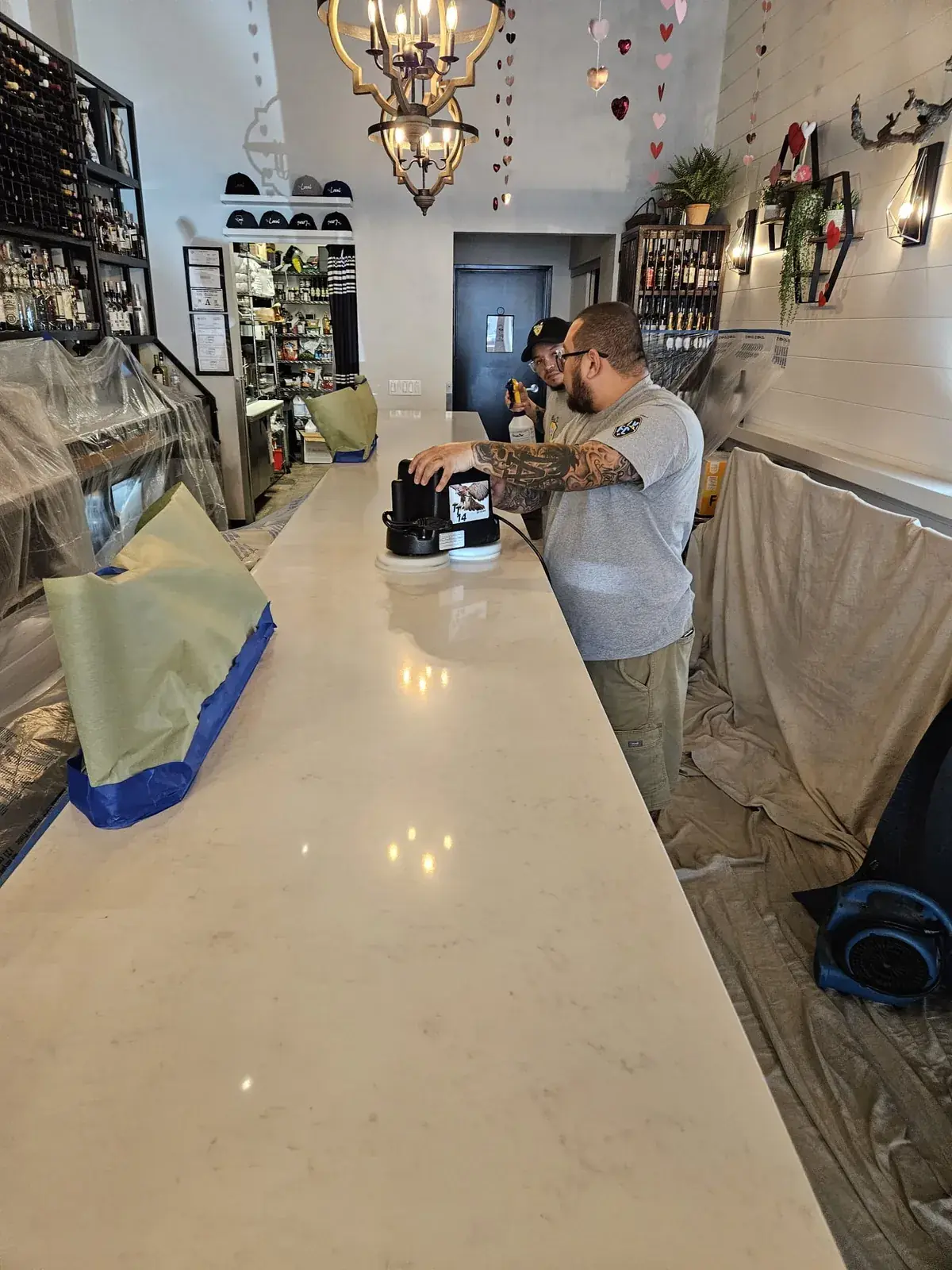
- Find out whose quartz it is. Brands differ in resin formulation and in which chemicals they approve, and that changes what is safe to put on it during a repair.
- Ask what lives on that spot. Quartz damage almost always has a specific cause rather than gradual wear, so the useful question is what has been sitting there. A hot appliance base, a rubber mat, a cleaning product, a skylight overhead.
- Read it in raking light to see whether the surface texture has changed or only the color.
- Check edges, seams, and appliance vents, because thermal-shock cracking and dishwasher-steam fatigue both show up in predictable places.
- Start with the mildest thing that could work. A pH-neutral clean and a second look, before anyone considers resin fill or refinishing. The wrong product on quartz resin makes a small problem more visible, not less.
What we can and cannot fix
- Small chips take a color-matched UV-cured or two-part acrylic resin, shaved flush. On a minor defect this often disappears.
- Mild dulling from abrasive cleaners sometimes improves with professional buffing, though matching the original factory sheen exactly is not something we will promise.
- Cleaning residue and light film clear with a straightforward pH-neutral clean.
- Plasticizer discoloration is difficult to remove. Take the mat off, avoid returning it to the same spot, and have the mark assessed before using stronger products.
Where quartz restoration has limits
Heat scorching is permanent. Manufacturers typically exclude it from warranty as misuse. It cannot be honed out, because there is no separate finish layer to grind back to, and stone diamond pads risk cooking the resin further.
UV yellowing is equally final. Once the polymer has photo-oxidized, no polish or coating restores the original color.
More broadly, quartz cannot be honed or repolished the way natural stone can. Sanding into it disrupts the resin-and-aggregate structure instead of resurfacing it, which is a real difference in kind rather than a matter of technique.
Past a certain size, heat, chemical, or UV damage becomes a replacement discussion. Matching factory gloss and aggregate pattern across a large repair is close to impossible to do invisibly, and a bad repair reads worse than the damage did.
Everyday situations that can leave marks on quartz
Quartz works well in busy kitchens, but many of the calls we receive start with something ordinary. An air fryer or slow cooker sits directly on the countertop. A rubber drying mat stays in the same place for months. Someone uses a strong degreaser or scrubs a mark with a melamine foam pad.
Heat may leave a pale or yellow mark. Mats can leave an outline in the resin, and abrasive cleaning can create a dull spot that becomes more visible under side light.
Start with a mild cleaner and soft cloth. If the mark stays, stop scrubbing and send us a photo. More abrasion can make a repairable problem harder to blend.
How Richmond homes can affect quartz
Heat and prolonged direct sunlight are the main environmental concerns. Quartz under a skylight or beside a large unshaded window may discolor over time, while hot cookware and heat-producing appliances can damage the resin much faster.
Richmond humidity does not absorb into quartz, but moisture can still affect seams, caulk, and the cabinetry underneath. Keep the sink area dry and investigate an opened seam or lifted section before moisture causes more movement below the countertop.
How to care for quartz
- A mild pH-neutral cleaner and a soft cloth, which genuinely covers day-to-day use
- Do not apply a penetrating stone sealer
- Trivets and hot pads under everything warm, small appliances very much included
- No silicone or rubber mats parked in one place for weeks
- Skip undiluted bleach, heavy alkaline cleaners, and melamine foam scrubbers
- Check your brand’s own care page, since approved chemicals vary between manufacturers
When it is worth a call
Call about a heat mark, an unexplained yellow shape, a chip near an edge or seam, or any crack. Once quartz is past the residue stage it is rarely a cleaning fix, and the wrong product makes the eventual repair harder.
A photo showing the shape and location of the mark, plus a note about what usually sits there, is normally enough for us to name the cause before anyone drives out.
Common quartz questions
Can I seal my quartz countertop like I would granite?
No. Quartz has very little pore space, so penetrating sealer has nowhere useful to go. It can dry on top as a film that attracts residue and makes the surface harder to clean. Follow the care instructions from your quartz manufacturer and skip products sold for sealing natural stone.
Can a heat scorch mark on quartz be polished out?
Almost never, and the reason is structural. Scorching is the resin itself cooking and discoloring, usually starting around 300°F, so the damage is chemical and it goes down into the material rather than sitting on it. With granite there is stone underneath to grind back to. With quartz there is no separate finish layer, just resin and aggregate mixed together, and abrasives disturb that mix rather than resurfacing it. Diamond pads also generate heat, which is the thing that caused the problem. Small marks are sometimes improved with a color-matched resin fill. Large ones are a replacement conversation and we will say so.
There's a yellow shape on my quartz that looks like a stain but won't clean off. What is it?
Check whether it matches the outline of a dish mat, and it usually will. Silicone and rubber mats left in one place for weeks leach plasticizers straight into the quartz resin, leaving a yellow shape in the exact footprint of the object. It is not on the surface, so cleaners and poultices have nothing to work on. The discoloration is inside the resin now. There is no reliable removal, which makes this one of the few countertop problems where the only real answer is not letting it happen: move mats, or do not use them on quartz.
Is quartz really "indestructible" the way it's often marketed?
Quartz is highly durable and easy to maintain, but no countertop is indestructible. It resists absorption and common food acids, and it never needs sealing. High heat, undiluted bleach, strong alkaline cleaners, hard impacts, and prolonged direct sunlight can still damage the resin or the finish.
Is a Magic Eraser safe to use on quartz?
We would keep it away from quartz. Melamine foam is an abrasive, roughly 3000-grit, so it does not lift a mark, it sands it off along with the factory sheen underneath. What you get is a clean spot that is permanently duller than everything around it, and that halo does not buff back out. A pH-neutral cleaner and a soft cloth handle essentially everything quartz meets in normal use.
Can chips or cracks in quartz be repaired?
Small chips, yes, and often well. A color-matched UV-cured or two-part acrylic resin fills the void and gets shaved flush, which on a minor defect can be close to invisible. Larger damage is harder than people expect, because a repair has to match three things at once: the color, the aggregate pattern, and the factory gloss. Missing any one of them makes the fix more noticeable than the chip was. Past a certain size, replacing the affected section is the honest recommendation.