
Corian Countertop Repair in Richmond, VA
Corian is a smooth, versatile solid surface that can be renewed instead of replaced in many situations. Its color runs through the material, so scratches, knife marks, haze, and many heat marks can often be sanded out and refinished in place. We identify the damage, match the surrounding sheen, and explain when a simple refinish is enough or a structural repair is needed.
Google Reviews
Scroll to read all 9 reviews →
“Great work and even better customer service. Very professional, easy to work with, and you can tell they take pride in what they do. Definitely recommend Precision Floor & Surface Restoration if you need your floors or countertops brought back to life.”★★★★★
“Absolutely amazing work! From start to finish, everything was handled professionally and with great attention to detail. They took the time to make sure everything was done right, and the results speak for themselves. The floors and surfaces came out looking incredible, and you can tell they genuinely take pride in their work. I couldn’t be happier with the finished product and would definitely recommend them to anyone looking for quality work and great service. Five stars all the way! ⭐⭐⭐⭐⭐”★★★★★
“Precision Floor & Surface Restoration exceeded my expectations! Professional, punctual, and detail-oriented from start to finish. My floors look amazing, and the quality of work was outstanding. Highly recommend to anyone looking for top-notch floor and surface restoration services.”★★★★★
“Removed stains that previous cleaning services could not. Made the impossible - possible!”★★★★★
“Great quality work! Very professional with communication!!”★★★★★
“Clean and very professional. Highly recommend”★★★★★
“I highly recommend his floor cleaning services! He’s reliable, professional, and does an excellent job. My floors looked amazing, and I couldn’t be happier with the results.”★★★★★ ★★★★★
Why Corian is so repairable
Corian Solid Surface is made from acrylic resin, mineral filler, and pigment. The color and composition continue through the full thickness instead of sitting in a printed or coated layer.
That allows us to sand below a scratch or cloudy spot and expose more of the same material. The repaired area can then be blended back to the surrounding matte, satin, or gloss finish.
Other solid-surface brands, including HI-MACS, Wilsonart Solid Surface, and Avonite, often respond to a similar refinishing process. We still confirm the exact material before starting.
Why Corian requires everyday care
Corian is softer than granite, quartz, or porcelain. Cutting directly on it, sliding cookware, or using an abrasive pad may leave visible scratches and uneven sheen.
High heat and strong solvents can also discolor or cloud the acrylic surface. Trivets, cutting boards, and gentle cleaners prevent most of the damage we see.
The advantage is repairability. Many marks that look permanent can be removed through progressive sanding and careful sheen matching.
What we get called about around Richmond
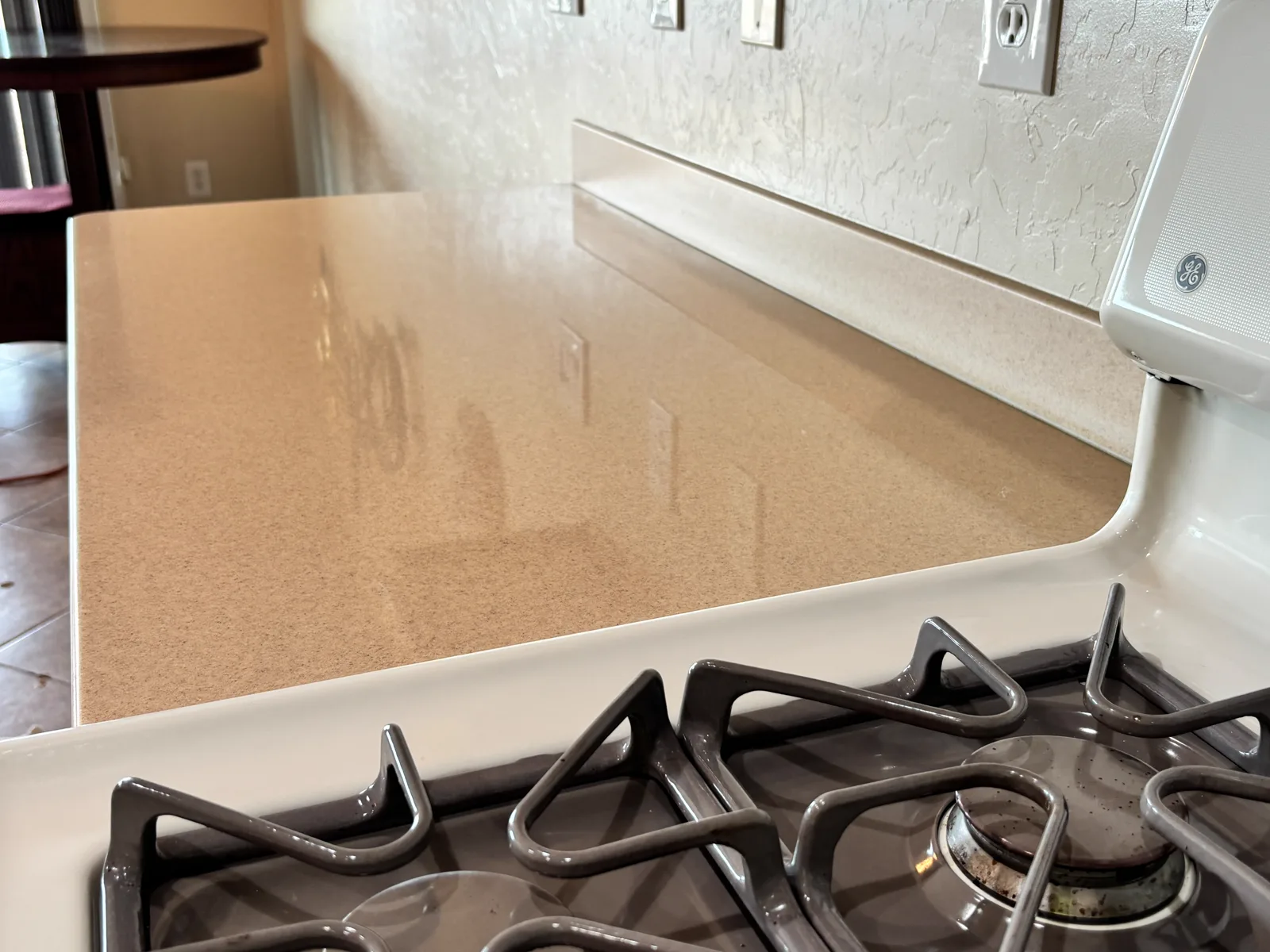
- Fine scratching and patchy sheen, the most common by far, from cutting straight on the surface, sliding cookware, abrasive pads, or an earlier DIY sanding attempt that left a dish
- Heat marks and scorching, showing as white rings, discoloration, roughness, or blistering from hot pans, air fryers, slow cookers, and instant-boiling taps
- Cracks, usually from heat stress, square rather than radiused internal corners, a failed seam, or movement in the cabinets below
- Seam failure, appearing as a darkening line, a ridge you can feel, actual separation, or a crack running outward from the joint
- Surface film, sitting on top only, since the material absorbs nothing
- Chemical clouding, a milky white haze where acetone, paint thinner, or oven cleaner softened the acrylic binder
Residue, stain, etch, or damage?
Two of these four barely apply, and the one that does has an unusually good outlook.
- Residue or film is deposits or cleaning residue sitting on the surface. With zero porosity this is the easiest condition on the entire site to resolve, and a wipe-down handles it.
- Stain in the absorbed sense does not really happen here. What gets reported as a stain is usually chemical clouding or surface residue instead.
- Etch does not apply. No calcium carbonate, so acid has nothing to react with.
- Damage is the real category: scratches, heat marks, chemical clouding, cracks, and seam failure. Nearly all of it responds to the same answer, which is sanding and refinishing.
How we approach a Corian counter
- Confirm which product it is. Corian Solid Surface, Corian Quartz, Corian Endura, or a competing solid surface. Getting this wrong sends the whole repair down the wrong road.
- Read the mark in raking light. A scratch pattern, a heat ring, a crack radiating from a corner or cooktop, and a chemical haze each look distinct once you light them from the side.
- Look at the assembly. Cabinet and substrate movement, how the seams were built, and whether internal corners were cut square or radiused. Square corners concentrate stress, and a crack with a structural cause needs that cause addressed too.
- Test in a hidden spot. A light sanding test confirms how deep the damage goes and how the sheen will match before committing to a full refinish.
What the work looks like
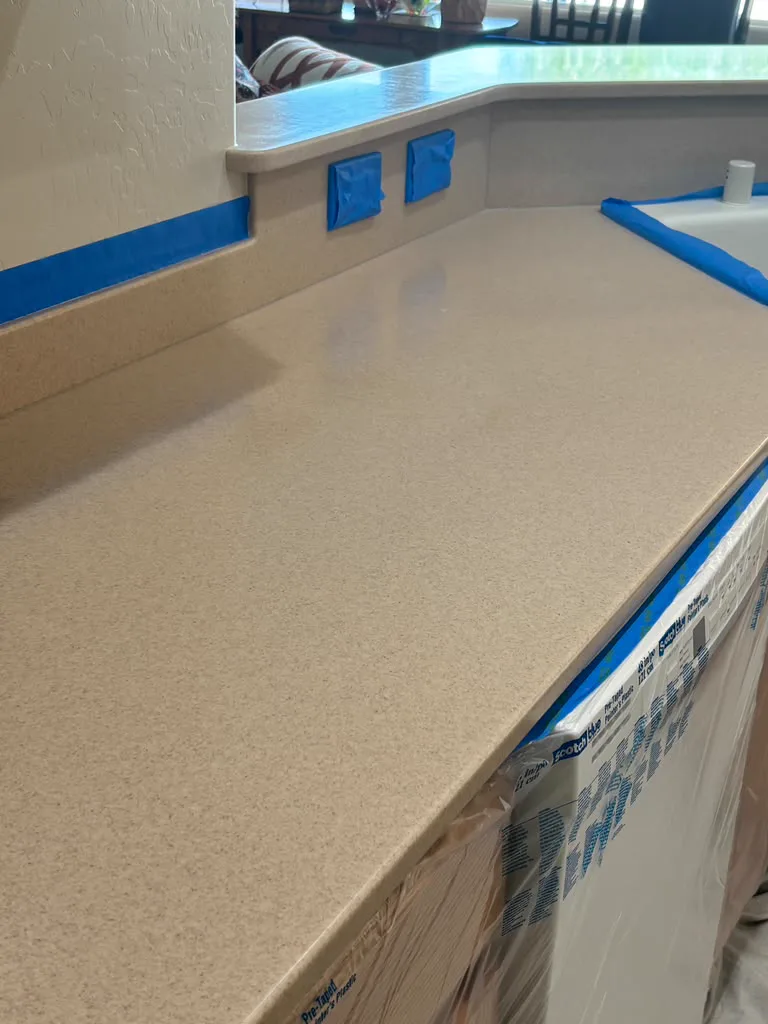
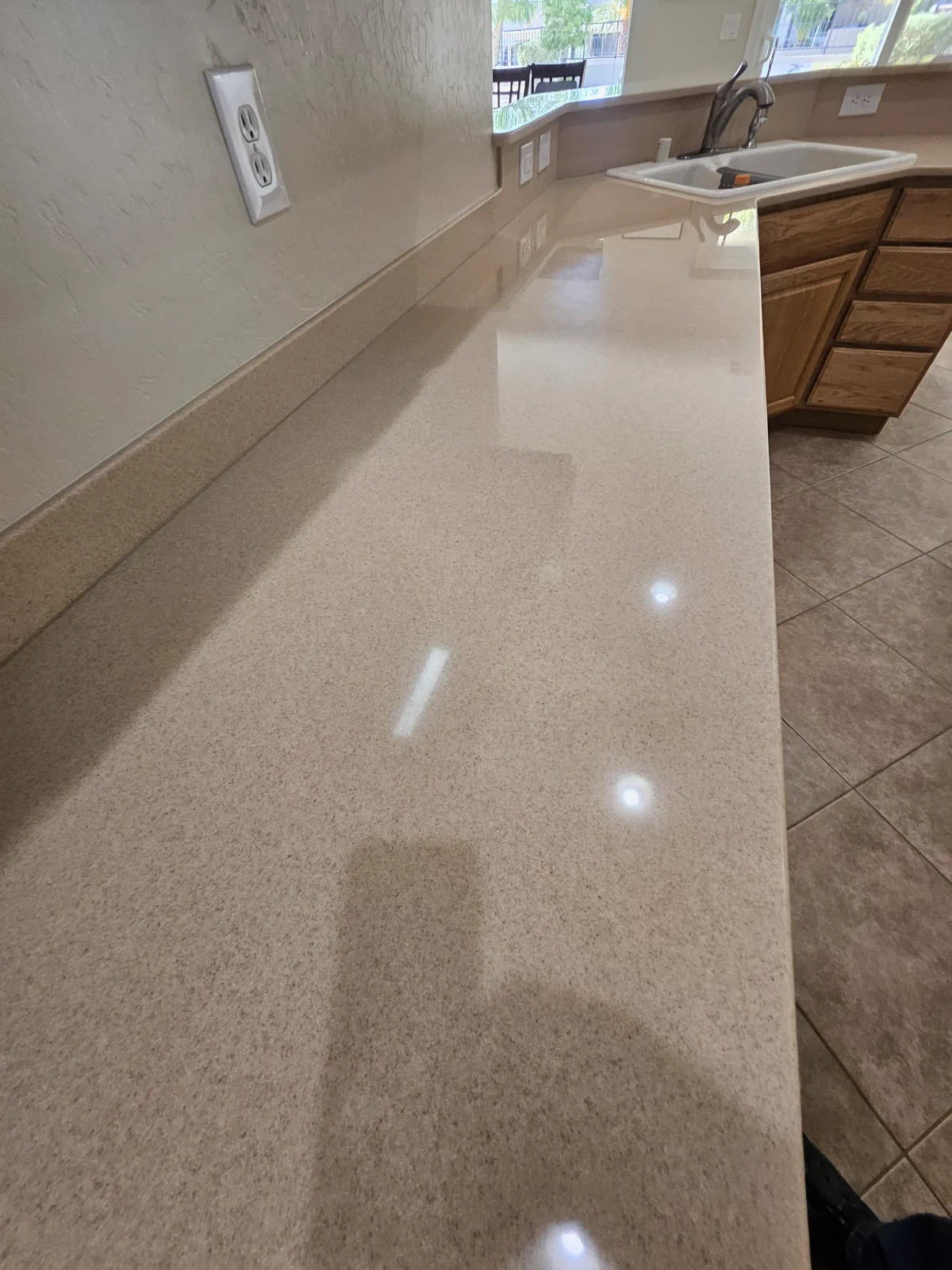
This is where Corian separates from everything else here. Most scratches, heat marks, and chemical clouding come out on site, with the countertop staying where it is.
The sequence is cleaning and degreasing, then progressive sanding from coarse to fine in wide overlapping strokes that extend well past the damage so no dip is left behind, then matching the sheen. Matte and satin get buffed with a conditioning pad. Semi-gloss and high-gloss need the finer abrasive steps plus a buffing compound.
Structural damage takes a different route. Cracks get routed into a clean V-groove, then filled with color-matched acrylic seam adhesive if narrow, or fitted with a dutchman inlay strip if the break is wider, and sanded flush afterward.
Small chips and gouges often fill directly. Larger ones may need the area routed out and a matching insert set in.
Where Corian restoration has limits
Heat damage spread across a large area stops being a spot refinish. So does structural cracking severe enough to compromise a section.
And water that has reached the substrate through a failed seam is a different problem entirely, because the countertop can look fine while the particleboard under it has swelled. At that point section or full replacement is the practical answer.
Everyday situations that can damage Corian
Corian damage usually comes from normal kitchen routines. A knife is used without a cutting board, cookware slides across the same area every day, or a hot appliance sits directly on the countertop.
Because Corian is non-porous, spills and water marks normally stay on the surface. Warm soapy water removes most residue. A mark that remains may be a scratch, heat ring, chemical haze, or damage at a seam.
Stop before using a harsh solvent or abrasive scrubber. Many remaining marks are repairable, but the wrong cleaning product can enlarge the dull area and make the final sheen harder to match.
How heat and Richmond humidity affect Corian
Heat is the main concern for the Corian surface. Air fryers, slow cookers, hot cookware, and boiling water in an integrated sink can concentrate enough heat to discolor or stress the material.
Use trivets under hot appliances and cookware. When pouring boiling water into a Corian sink, run cold water at the same time to help carry the heat away.
Richmond humidity does not absorb into Corian, but moisture can linger around a failed seam or sink cutout and affect the cabinetry underneath. An opened seam, loose sink, or musty cabinet should be inspected before the surrounding support deteriorates.
How to care for Corian
- Warm soapy water in circular motions, which keeps the sheen even, then rinse and dry fully
- Never pour boiling water into a Corian sink without the cold tap running alongside it
- Cutting boards and trivets, because prevention still beats repair even when repair works
- Keep acetone, paint thinner, and oven cleaner away, since all three soften and cloud the acrylic binder
- No stone sealer, which does nothing here except leave a film
- Skip waxy window cleaners, which dull the finish over time
When it is worth a call
Call for any heat mark, deep scratch, crack, seam separation, or cloudiness that survives normal cleaning.
Many Corian surfaces can be renewed in place, so an assessment is worthwhile before accepting a mark as permanent or pricing a replacement countertop.
Common corian questions
Is Corian the same thing as Corian Quartz or Corian Endura?
No, and the shared brand name causes real confusion. When a homeowner says Corian they almost always mean Corian Solid Surface, the acrylic-and-mineral material this page is about. DuPont also sells Corian Quartz, which is engineered stone, and Corian Endura, which is porcelain. Those three materials have almost nothing in common in how they are repaired. Competing solid-surface brands including HI-MACS, Wilsonart Solid Surface, and Avonite behave essentially like Corian Solid Surface. If you are unsure which you own, confirm it before applying any advice here.
Is my Corian actually repairable, or does it need replacing?
Repairable, in the large majority of cases, and the reason is structural rather than lucky. Corian Solid Surface has zero porosity and carries its color and composition through the entire thickness instead of in a printed or coated layer. That means sanding into it exposes more of the same material rather than something different underneath, which is exactly what you cannot do with porcelain or engineered quartz. Scratches, heat marks, absorbed-looking discoloration, and chemical clouding usually come back to factory appearance. Replacement is mainly for severe structural cracking or heat damage across a large area.
Can a scratch or heat mark on Corian really be made invisible?
Usually. Since there is no separate finish layer to grind through, the damaged area gets worked with a progressive abrasive sequence from coarse to fine, in wide overlapping passes that run well past the mark itself. That feathering is what prevents a shallow dip where the repair sits. Then the sheen gets matched to the surrounding surface, and how that is done depends on the finish. Matte and satin come back with a conditioning pad. Semi-gloss and high-gloss need a finer abrasive progression plus a buffing compound.
What happens if I pour boiling water into a Corian sink?
DuPont warns against it directly. Boiling water going into a Corian sink without cold water running at the same time can damage the sink area. The cold tap running alongside carries the heat away rather than letting it concentrate. It is an easy habit to pick up and it costs nothing, which makes it cheap insurance against a repair you would otherwise be paying for.
Should I seal my Corian countertop?
No. Porosity is zero, so a stone sealer has nothing to penetrate and no job to do. What it actually does is sit on the surface as a film that feels tacky and attracts dirt, leaving you with more cleaning than you had before. If someone recommends sealing solid surface, they are applying stone logic to a material that is not stone.
Why do dark Corian colors show scratches more than light ones?
It is contrast, not durability. The material performs identically regardless of pigment. But a fine scratch scatters light differently than the surface around it, and against a deep, heavily pigmented color that difference is easy to see, while a light or patterned color hides it. So dark Corian in a busy kitchen will look worn sooner even though it is not actually wearing faster. Worth knowing at the point you choose a color rather than after.